

Extended Lactation Trial Update 6 August 2026
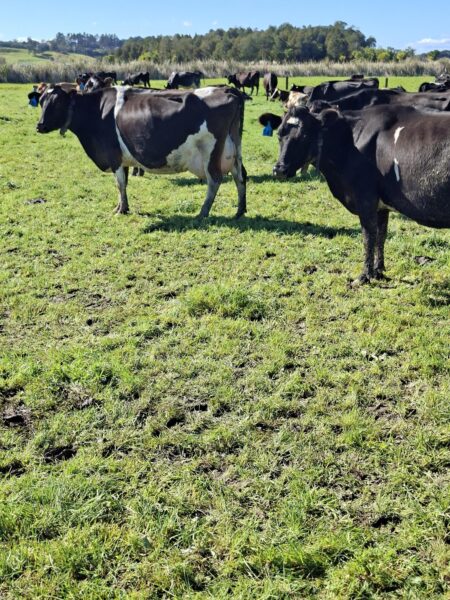
This project compares the impact on productivity, profitability, people and the environment on three farms:
- Baseline Farm – Spring calving, twice-a-day milking, 3.0 cows/ha
- Extended Lactation TAD Farm – 50% herd calving each year, full season twice-a-day milking, 3.0 cows/ha
- Extended Lactation OAD Farm – 50% herd calving each year, full season once-a-day milking, 3.0 cows/ha
This project is funded by DairyNZ.
| Update 6th August 2026 | Baseline Farm | EL TAD Farm | EL OAD Farm |
| Average Pasture Cover (kg DM/ha) | 2,236 | 2,216 | 2,153 |
| Pasture Growth (kg DM/ha/d, last 2 weeks)* | 28 | 27 | 28 |
| Current Rotation Length (days) | 41 | 46 | 48 |
| Cows in milk/Total Cows | 51/81 | 63/82 | 58/82 |
| Average Body Condition Score
(EL = Extended Lactation, NC = New Calvers) |
4.7 Milkers |
4.3 EL Milkers
4.7 NC Milkers |
4.5 EL Milkers
4.6 NC Milkers |
| SCC (‘000) | 125 | 171 | 200 |
| Litres/cow/day (average of farm) | 20.1 | 14.6 | 12.2 |
| Kg MS/cow/day | 1.96 | 1.62 | 1.35 |
| Kg MS/cow, season to date | 15 | 52 | 45 |
| Kg MS/ha, season to date | 44 | 155 | 133 |
| Supplement offered (kgDM/c/d) | Milkers 0
Dries 2.6 PKE |
Milkers 4.4 PKE
Milkers 2.1 bale Dries 2.6 PKE Dries 1.9 bale |
Milkers 4.7 PKE
Milkers 2.7 bale Dries 2.4 PKE Dries 1.3 bale |
| Purch Supp Fed, season to date (kg DM/c) | PKE 186
Baleage 41 |
PKE 237
Baleage 99 |
PKE 231
Baleage 102 |
| Managers Worry Score (1 = Low, 10 = High) | 3 | 5 | 6 |
| Rainfall (last two weeks) | 30 mm | ||
*Pasture growth rates are calculated using platemeter readings in conjunction with Halter estimates
CURRENT MANAGEMENT
- Cool weather is keeping a cap on pasture growth. Pasture utilisation has been good for this time of year which is helping hold pasture covers steady.
- The new rubber matting in our herd home allowing us to hold the dry cows on the feed pad for periods to prioritise pasture to the milking cows.
- Some of the Extended Lactation cows have dropped milk production in recent weeks, especially on the once-a-day farm. We will have a close look at these cows after the next herd test in two weeks’ time.
- Nitrogen continues behind the cows at 80 kg/ha urea.